THE SELF UNDERSTANDING PROJECT
Understand how you work, so you can stop living against yourself.
The Self Understanding Project is a 58-page downloadable, workbook-based program created by mental health occupational therapist Tessa Lloyd. It helps adolescents and adults understand how they think, feel and respond, make sense of recurring patterns and translate self-understanding into practical changes that support everyday life.
The workbook can be completed digitally or printed and revisited over time. It is a self-paced educational and reflective resource, not therapy, diagnosis, clinical advice or crisis support.
$39 AUD

You know something needs to change. You’re just not sure what would actually help.
Perhaps you find yourself pushing through exhaustion until you have nothing left to give, or adapting your personality to fit others' expectations without realizing the cost. You might experience cycles of holding everything together with rigid structure, only to find yourself completely overwhelmed by the very demands you worked so hard to manage. These are recognizable signs of masking, overriding personal needs, and living in a state of disconnection from your own energetic and sensory capacity.
Why understanding comes first
Meaningful change is incredibly difficult when you don’t yet understand what is happening beneath the surface. Without that foundation, generic advice—like journaling prompts, self-care tips, or productivity systems—can feel impossible to apply. You might find yourself following boundary scripts that don't fit your relationships or attempting routines that ignore your sensory threshold.
Real transformation starts when we stop looking for external solutions and start looking at our own internal patterns, capacity, and needs. Before we can choose a new path, we must understand the one we've been walking.
What has shaped me, what are my mind and body communicating, and what do I need now?
This may be for you if…
- You feel frequently overwhelmed or disconnected from your own needs.
- You know something needs to change but don't know where to begin.
- You often push through discomfort until you are completely depleted.
- You catch yourself adapting to others' expectations at your own expense.
- You struggle to identify or communicate what you need to those around you.
- You feel responsible for managing other people's emotions.
- You feel you've lost touch with your identity, interests, or meaningful activities.
- You find yourself in cycles of holding everything together, followed by burnout.
- You want more guidance and structure than an open-ended journal provides.
The three-part journey
Part One: Understanding who I am
Explore your unique identity, values, and strengths. We look at nervous system responses, sensory triggers, energy patterns, and the subtle body signals that serve as early signs of overwhelm.
Part Two: Understanding how I became me
Look back at the life experiences and formative relationships that have shaped your learned roles and mask. Consider what your patterns were trying to protect or provide.
Part Three: Building a life that fits
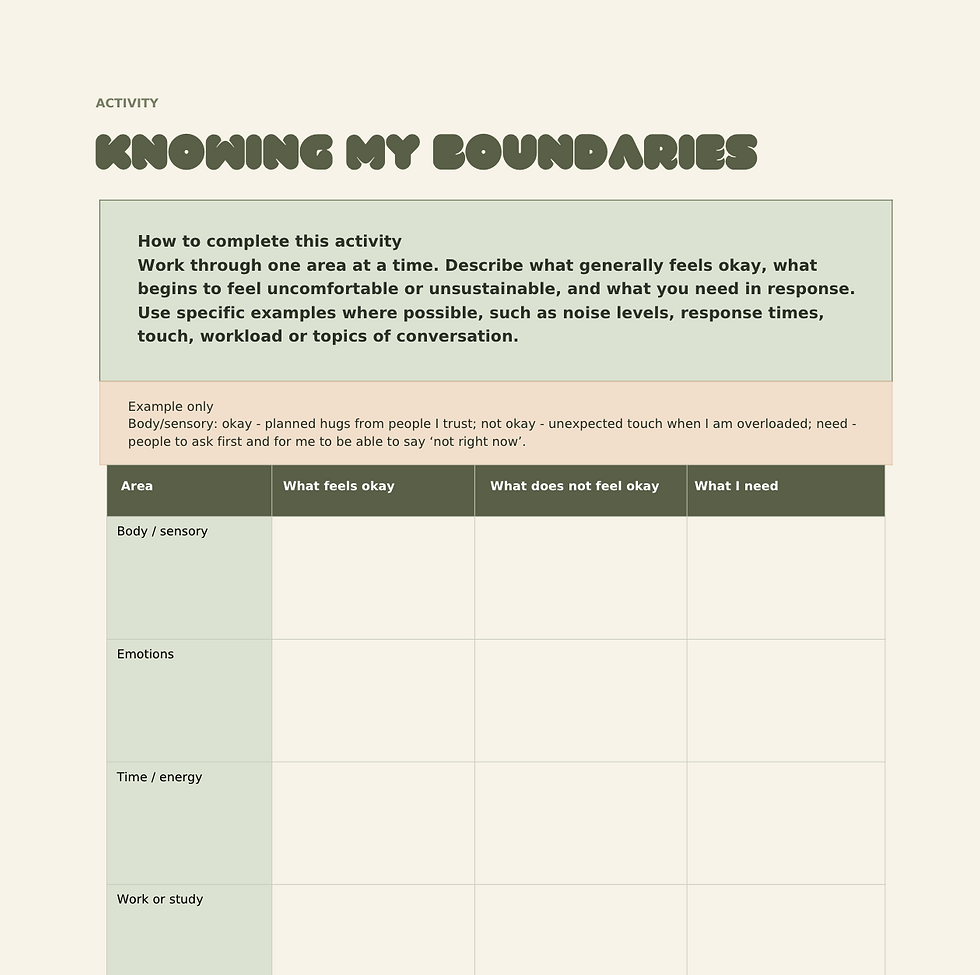
Translate your insights into practical decisions about boundaries, support, routines, and meaningful activities. Create a personalized plan for sustainable living.
Notice. Understand. Choose.
Notice how you think, feel and respond.
Understand the context and needs beneath your patterns.
Choose what you want to keep, adapt, support or change.
What will become clearer
- Recognising what contributes to overwhelm before reaching your limit.
- Understanding how your nervous system and sensory experiences affect daily life.
- Identifying emotions through thoughts, body sensations and behaviour.
- Understanding what recurring patterns may be protecting or providing.
- Recognising when you are masking or overriding your own needs.
- Identifying values, strengths, and sources of genuine meaning.
- Noticing when your strengths are being used beyond your capacity.
- Identifying and communicating personal boundaries with clarity.
- Working out what kinds of support are genuinely helpful for you.
- Building a personalized self-understanding plan for everyday life.
Turning new insights into practical tools
The Self Understanding Project offers a structured, step-by-step pathway that moves beyond open-ended questions. It provides a compassionate framework for understanding patterns without judgment, using an occupational therapy perspective that considers the whole person—their environment, routines, and activities.
This isn't about becoming more productive or learning to tolerate an unsustainable life. It is about turning deep insight into practical experiments, helping you decide what could be softened, shared, or changed to better support your well-being.



About the creator
Tessa Lloyd is a mental health occupational therapist and the founder of Our Mindful Youth. She created this resource after noticing that many people could accurately describe what they found difficult in their lives, but had received much less support to understand why their specific experiences made sense, and therefore how to best support themselves.
Her work is dedicated to providing a warm, credible, and non-clinical space for self-discovery, respecting neurobiology and celebrating individual identity.
What you receive
Frequently asked questions
Do I need a diagnosis?
No. This resource is designed to be accessible to anyone curious about their own neurobiology, identity, and patterns, regardless of whether they have formal clinical labels.
What if I don't know what I need?
That is exactly where we begin. The first part of the project is dedicated to helping you identify your unique signals and sensory profile.
How is this different from a journal?
A journal is open-ended. This project is a guided pathway with specific exercises, examples, and structured reflection to help you build a concrete plan.
Do I need to complete it in order?
While it follows a logical path, you are encouraged to move at your own pace and revisit sections as they become relevant to your life.